
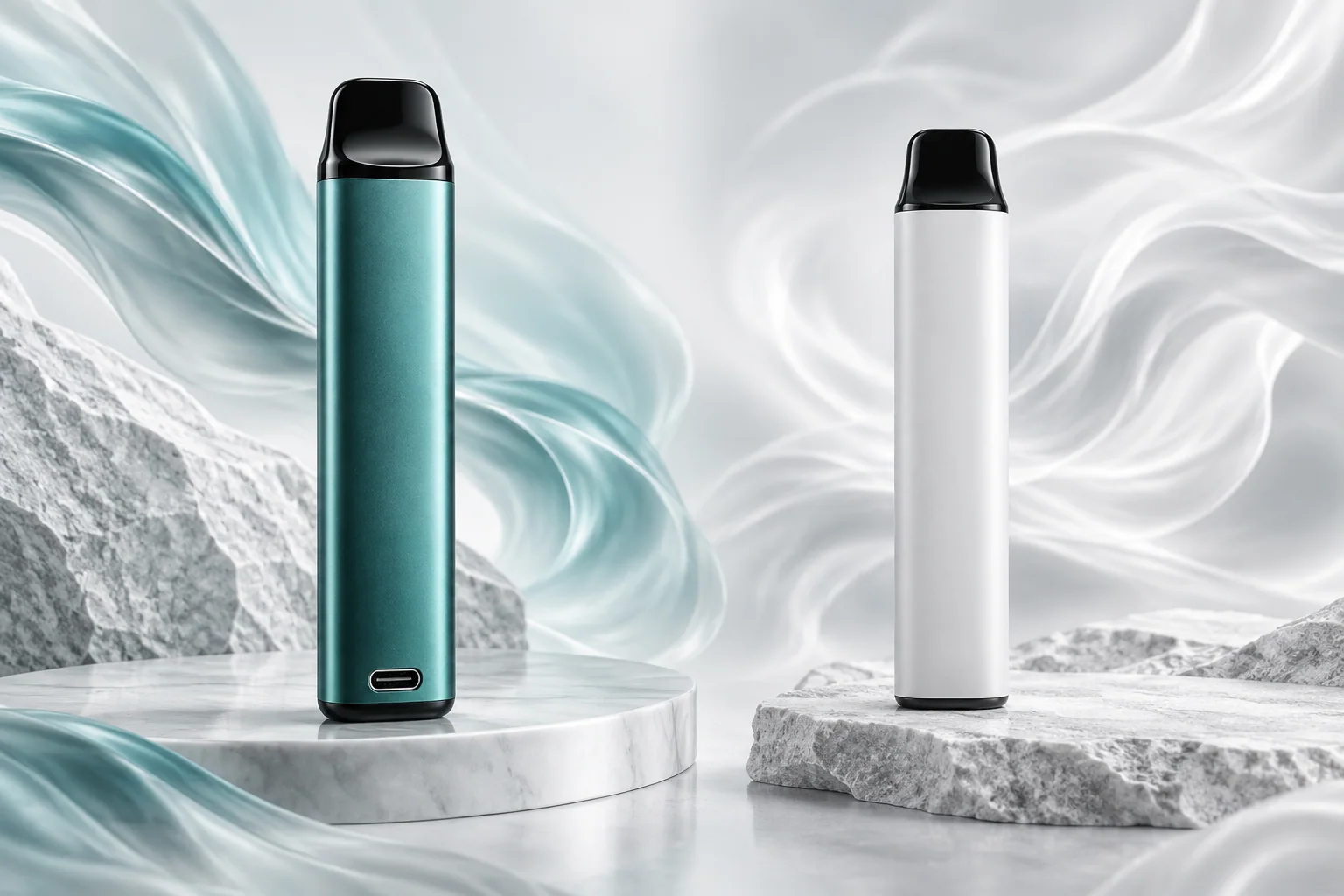
Our verdict: buy rechargeable when capacity demands it
I recommend a rechargeable disposable vape for any device carrying enough e-liquid to outlast one battery charge. That is the decisive difference in 2026. Recharging lets the battery keep pace with the liquid already sealed inside the device. A traditional non-rechargeable disposable is the better fit only when simplicity, low capacity, and zero charging responsibility matter more than long service life.
Neither format is refillable by definition, and neither should be treated as permanent hardware. The practical question is whether the battery can deliver the liquid capacity you paid for. Our rechargeable disposable vape guide shows current US devices with confirmed charging, battery, coil, and capacity information so that decision starts with facts instead of packaging.
The difference in one table
| Factor | Rechargeable disposable | Non-rechargeable disposable |
|---|---|---|
| Power | Battery can be recharged through USB-C or a stated dock | One factory charge only |
| Liquid | Usually designed around a larger sealed reservoir | Usually paired with a smaller reservoir |
| Controls | More likely to include screens, modes, or airflow adjustment | Usually draw-activated with fixed output |
| Daily routine | Requires safe charging and cable access | Use until depleted, then replace |
| Best use | Longer service life and clearer status information | Short-term simplicity and compact size |
These are format tendencies, not permission to assume a specification. Confirm the actual battery, connector, liquid capacity, and controls on the product page. A rechargeable device with missing battery data is not automatically a better buy than a clearly documented compact disposable.
Why battery and liquid capacity must match
A sealed device fails its basic value test when the battery dies while usable liquid remains. Rechargeability solves that mismatch, but it does not increase the amount of liquid in the tank. A 20 mL device remains a 20 mL device after ten charges. The connector simply restores battery energy so the coil can continue vaporizing the liquid already present.
Battery figures also need context. A 1,000 mAh cell has more nominal capacity than an 800 mAh cell, but output power, screen use, coil resistance, and draw duration change the interval between charges. High-power Boost or Turbo modes drain energy and liquid faster. I value a visible battery indicator and explicit mode information more than a bare milliamp-hour number.
Cost, convenience, and control
Rechargeable disposables usually cost more upfront because they combine larger reservoirs with charging circuits, indicators, and sometimes adjustable airflow or wattage. That higher price makes sense only if you use those capabilities. If your priority is a compact device for limited use, a smaller non-rechargeable format can be the cleaner purchase.
For regular use, rechargeable models win on control. Battery and liquid displays reduce guesswork. Adjustable airflow changes draw resistance. Multiple power modes let you choose between stronger output and longer endurance. Those features do not guarantee quality, but they make performance easier to understand and manage. Browse the full range of disposable vapes to compare these formats without treating every device as equivalent.
Safety and charging discipline
Use only the charging method stated for the device, keep the connector dry, place the product on a stable nonflammable surface, and stop using damaged hardware. Do not leave a disposable charging unattended or continue charging when it becomes unusually hot. A rechargeable label is not an invitation to open, refill, repair, or modify a sealed device.
Replace the product when the liquid is exhausted, flavor turns persistently burnt, the device leaks, the casing swells, or charging becomes unreliable. Recharging is maintenance of the battery, not restoration of the coil or liquid. That distinction prevents the most common misuse of the category.
Which should you buy in 2026?
Choose rechargeable when you want a larger sealed capacity, status visibility, or power and airflow controls. Choose non-rechargeable when you value the smallest possible routine and the device is genuinely designed to finish its liquid on one charge. Do not decide from puff count alone: published puff totals are manufacturer estimates affected by draw length, power mode, airflow, and testing method.
My rule is direct. Match battery design to liquid capacity, confirm the connector and operating modes, then buy the simplest format that satisfies your real use. For a high-capacity purchase, the rechargeable format is the rational winner. For short, occasional use, a smaller fixed device remains valid.
Three mistakes that produce the wrong choice
The first mistake is buying from the headline puff count. That number does not describe draw length, test power, or real daily use. The second is confusing rechargeable with refillable. A charging port restores battery energy; it does not make a sealed tank user-serviceable. The third is ignoring package type. A replacement pod and a complete device can appear beside each other while requiring entirely different hardware.
Read the product name, package contents, and confirmed specifications as one set. If any core point is missing, compare another model before ordering. This discipline takes two minutes and prevents weeks of living with the wrong format.